Sunday, March 10, 2019

Reenactment of The Last Supper 2019 and 2020

I made the changes to the script as I mentioned I would last year in "The Reenactment of the Last Supper" by simplifying the words.  It went perfectly and no one stumbled or needed help in reading.  I also lengthened the play to add the scenes of the arrest in the Garden and the Crucifixion.  It now takes an hour.
It appeared to be the perfect amount of time for the play as the children weren't begging to stay in their costumes as they usually are.  I am thinking of perhaps adding the Resurrection but doing that in another session.   That's something for me to consider in the future.  My schedule is full for Lent.  This week we have our First Reconciliation during class time.  That has worked out so much better for us than doing it on a Saturday.  The week after that we will do the "Meditations of the Passion," and the next week, the "Liturgy of the Light Ceremony." 

This is how I dressed the prayer table for Lent.  I've kept the True Vine cross with grapes on the prayer table and have made two posters.  One is "What is Lent?" and on the back, "When is Lent?"  On the right is a poster of the Paschal Candle.  I've included the question on the bottom of the Lent poster, "Why did Jesus have to die on the cross?"  Then I asked, "Why did the Jewish leaders want Jesus crucified?"  I wanted to make sure they understood these difficult responses before doing the Reenactment of the Last Supper.  I was happy in that at
least three could answer each of these questions.  I've found that even though I can't always elicit answers from the others, they are thinking hard but just can't form the words.  Also, I have all 2nd graders this year.  In the past I've had 3rd graders as well and they ask very deep and thought provoking questions.

I set up the low tables before the children come in with the script booklets and names of the apostles, Mary and Mary Magdalene.  I've always included these women and it was especially appropriate this time because we did the crucifixion and I wanted them to be at the foot of the cross.

On the small table above is the wine chalice and the plate we will use.  I bring in Strawberry Lemonade for the wine and two bags of 20 tortillas for my two classes on Wednesday and Thursday.  I have 9 children in the Wednesday class and 15 in the Thursday class.  I lay one tortilla on the plate and a little lemonade in the chalice, telling the children that this is a play and they can pretend to break a piece off and take a sip.  They usually don't want to pretend with the tortillas.


They take the play very seriously and I stand on the side directing the scenes for those who didn't know it was their turn to speak.   I forgot to mention that I also lengthened the play by adding many narrations so that everyone would have a part.  So now they can't loose their place.  Children with reading and learning disabilities will need the extra help, of course.  I also added under their Apostle name on the name tags, the number of their narration part and the two who are soldiers who arrest Jesus.

When the Reenactment is over they ask if they can have a tortilla and they also get to enjoy the Strawberry Lemonade in paper cups - a little celebration for getting through the play and a job well done.


Reenactment of the Last Supper  -   2020

My aide and I getting the children ready to begin.  As there are no parts for the Apostles except John and Peter, the other children have 
a few narrations each.  We're showing them how to look for them.

Wednesday, February 6, 2019

The Wedding Feast (The Sacrament Retreat)


   The Wedding Feast 

   At the Sacrament Retreat, this is the third and last Parable that is presented.  The reason is because this is the hardest parable to analyze and teach to the children.  When I introduced parables I had told the children that Jesus had three purposes to teach using these parables.  The first was to teach how to treat your neighbor and that was discovered in the Good Samaritan.  The second was to teach how to pray and that was captured in the Insistent Friend parable.  The third reason Jesus taught these parables was to teach us how to get to heaven and how some people reject the call.  

When I start this presentation, I always ask, "How many of you have been to a wedding?"  Most often they have and I say, "Then you wore your very best clothes.  You would never have gone there dirty or with holes in your clothes as that would be an insult to the Bride and Groom's family who worked so hard to make the preparations and get the food ready so that it would be beautiful for everyone.  I show them the King and explain that he is giving a wedding to his son.  I place the other figures in the white robes for the children to see.  These other people have come to the wedding and as they have traveled so far by foot or donkey, it was customary for them to bath in a communal bath and dress in the beautiful robes provided by the King.  (The figure in the green robe I keep in the basket until he is introduced in the Bible Story.)

I take the children back to the Good Shepherd parable when I ask them, "Who is Jesus in this story and who are the sheep?"  "What is the Sheepfold?"  They know these answers and so I tell them I'm going to give them a clue because they already understand that the Sheepfold is either Heaven or the Church.  So the clue is that the Wedding Banquet Hall represents "Heaven."   I ask them to think about this carefully as I read the parable to them.

After reading the scripture I tell them that there are some different groups in this story who make very different choices.  So I ask, "Who are the people in the robes who have come to the wedding?"  I get some interesting answers, like "Angels and Saints."  Then I ask "Who are the people who refuse to come?"  One answer was, "They are sheep outside the sheepfold."  I was pleased with that answer as they refer back to the "Good Shepherd" parable to understand.  So "Yes," I say, "They are maybe people who don't believe in God (atheists) and no one has ever told them about Jesus. They could be people who just don't want to go to mass because their faith isn't very strong.  They could also be people of other faiths who go to other churches.  But then the King says, 'Go out into the byroads and invite the good as well as the bad.'  Do you remember in the Good Samaritan that he had compassion?   Jesus has compassion and he forgives all who come and ask forgiveness.  So if the bad come and put on the new garment, then they are ready to take the next step and begin to follow their faith.  They are ready to shed their old life of sin.  Then who is the person in the green garment who will not speak to the King or change into the new garment. But why then has he come?"  One answer surprised me, a boy said that this was the devil.

I tell the children that this man isn't ready to follow the Ten Commandments or the Maxims, words of Jesus on how to live his life. He is not ready to give up his old ways.  All he has to do is say, "Dear God, I'm sorry for my sins," and he will be welcomed.  But he is not ready.  When he is, the Lord will receive him with great rejoicing.

I say to the children that this is a special year for you all because you will be putting on a new garment and after saying that you are sorry for your sins in the sacrament of Reconciliation.  When you girls wear your beautiful white dresses and the boys wear their white shirts, ties, pressed pants and polished shoes, you are making a big change in your faith and now belong to the church family.  I also tell them how happy the people in the church are to see them receive the Blessed Sacrament.  They will watch them grow up by being altar servers, receiving Confirmation, joining choir or becoming a lector.  You will join the teen group and later graduate from high school and the parish will celebrate with you.  So the church family celebrates you and they will be watching and appreciating with joy.

This is my favorite parable and I always save it to last at the Sacrament Retreat because it is so rich in spiritual meaning.  

Monday, February 4, 2019

The Sacrament Retreat

  The Sacrament Retreat

Once a year we have a Sacrament Retreat at St. Andrew the Apostle Catholic Church to prepare our children for First Reconciliation and First Holy Eucharist.  We begin with the 9 a.m. Mass then go to our big gathering room, Madonna Hall, to split up into random groups by colors.  So there are four color groups and four rotations every 45 minutes.   Each of the three catechists do three Moral Parables which take about 15 minutes each.  Each of the four groups at some point during the day rotate to the church where there are two catechists who practice with them: one group go in the actual Confessional to learn how to go to Confession while the other group practice how to receive the host on their tongue and the wine.  We always have a wonderful hot dog luncheon for them with veges and dip, fruit cup and lots of homemade cookies and cupcakes.  They love this day!

Two weeks before this retreat, I have gone over the Ten Commandments and an examination of conscience which is a booklet I've made for all the students.  The next week we go over at least six of the Maxims with an examination of conscience in another booklet I've made for them.  In the inside cover of each of these booklets I've put the steps to go to Confession along with the Act of Contrition.   Our pastor has a specific version of this prayer that he wants the children to memorize.  I only mention this because each year we are joined by the local All Saints Catholic School for this retreat and they learn the old version.  (If anyone should want these booklets you can write to me and I will email them to you.)

In the above photo I show our prayer table and how I set it for this special day.  One of the parables of the day will be "The True Vine" given by one of the other catechists and so it is fitting to have the grapes on the vine as we refer back to this parable for the remainder of the year.  Actually the wrought iron cross that the grapes hang from was given to me by a very special friend,  Nellie Renterio, who I went through Level I and Level II training with in Phoenix. During my Level II training she let me stay with her every weekend.   I had to travel three hours to Phoenix and afterward three hours home, so she was a Godsend.  Those were long hard trips and I will never forget her hospitality and generosity to me.  So the cross has a special place in my home but I bring it into the atrium for the remainder of the year.  As you can see, "The Summary of the Law" sits at the left and "The Maxims" are to the right.  So I begin my lesson at the retreat with the "The Summary of the Law" and explain the Maxims as Jesus' own words in the Bible, as I really don't know if the other children have been taught them yet.

For the retreat I selected what I consider the most difficult of all the Moral Parables:  "The Good Samaritan," "The Insistent Friend," and "The Wedding Feast."  They tax my brain every year but  hopefully I've become better at teaching these difficult parables.   That being said, it's been seven years now that we've been preparing our children for the Sacraments and started Level II at our parish.  They become new again every year.

I begin the presentations as I said with "The Greatest of all Commandments."  I talk to them about how they are beautiful creations of God and that he loves us so much that he puts us on a pedestal and wants us to show our love to Him by loving each other.  Then I talk to them about Parables.  Some of these children may have never heard that word before and so I ask if anyone can tell me.  Then I explain what it was like 2,000 years ago when people had nothing like we do today.  We live like Kings and Queens with electricity and cars, etc.  So Jesus had to teach them by using Parables,  talking to them about what they knew so well, such as sheep herding and farming vegetables; the roads they traveled; and even about wedding celebrations, just to explain what he wanted them to learn and understand.  There were three important things he wanted the people to understand when telling a Parable:  First, He wanted them to learn how to treat their other people.  Secondly, He wanted them to learn how to pray.  Third and most of all, He wanted them to learn what they had to do to get into heaven and also what might keep them from getting to heaven.  So these three Moral Parables that I read and discussed at the Retreat teach these very three topics.   I suggest doing them in this order.

Go to "The Good Samaritan" link where I will go into the discussion on this parable that I used at the Retreat.  This parable covers "Love your neighbor as yourself."

Go to "The Insistent Friend" link for the discussion to this parable.  This parable covers "Be persistent in prayer."

Go to "The Wedding Feast" link for the last parable to discuss in depth.   This parable covers "How to get to Heaven."

Thursday, June 28, 2018

The Mystery of Life and Death (The Growing Seed)

The Grain of Wheat  and the Growing Seed


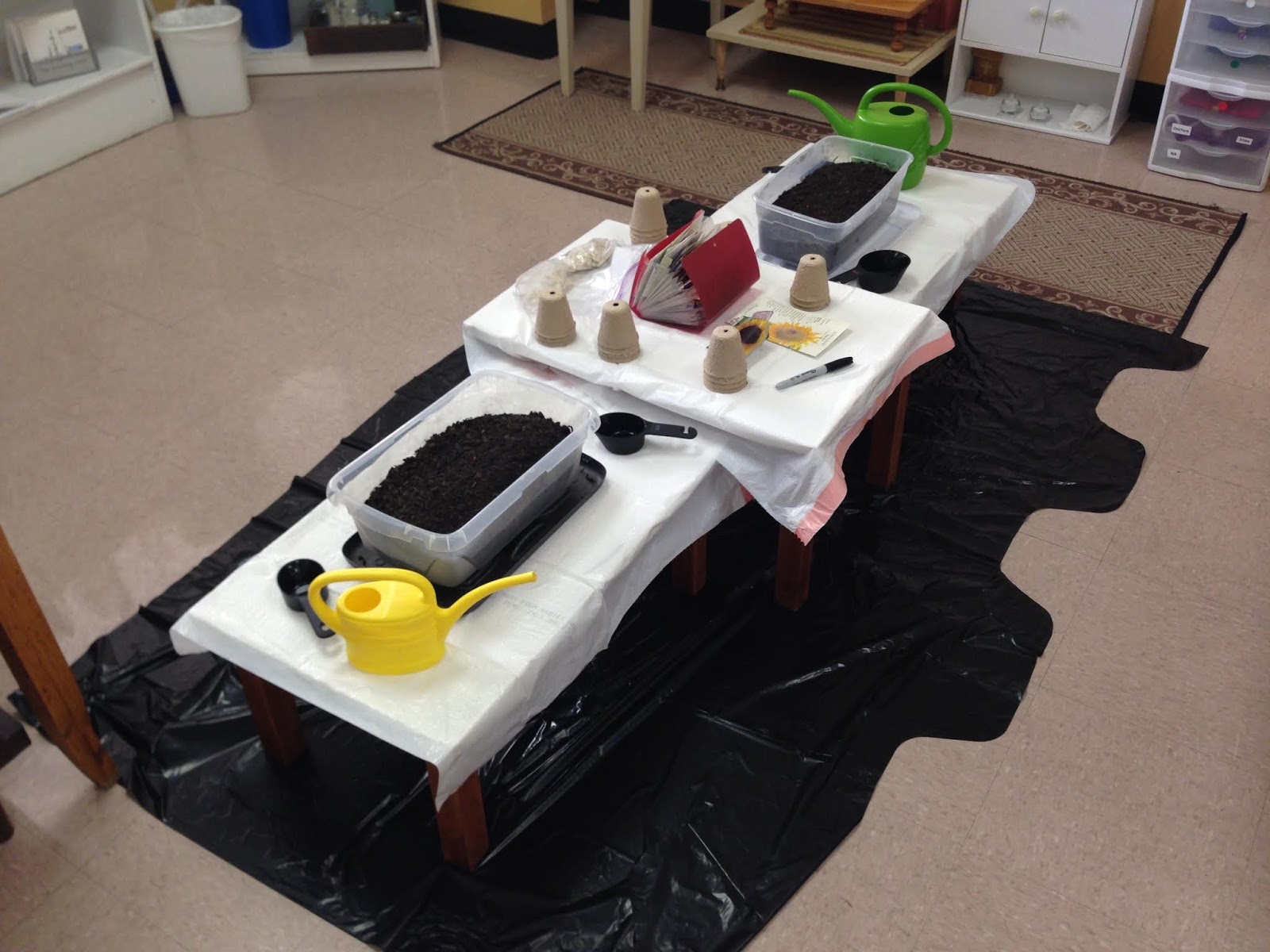
  In Level II, this has become my setup for the planting of the seeds after presenting "The Grain of Wheat" or as we also know it to be called, "The Mystery of Life and Death."

This was an extremely difficult parable for me to grasp each year comparing it to the Grain of Wheat."  So I studied it carefully and thoughtfully each year before I presented it.  What was difficult for me was the metaphor of the seed itself.  I've had to wrestle with this a lot.  So I've come up with this.  It is actually the entire plant that dies though the seeds, still living, fall to the earth and then create the new life of
another new plant.  We are to compare that to ourselves, "dying to self," to mean we give up the material world and things that mean so much to us in life, so that we recreate ourselves to live only for God.  So perhaps we explain it just like that - that the plant in dying is like us dying (but to self and our material world) and in doing so spread our love (seeds) to all others in the world giving example and spreading the word of God verbally and by example and creating (new plants) i.e. new lives, living for God as Christians.  I like that explanation best.  If anyone has a better analogy to offer, please share.  I heard an interesting take in a homily at daily mass today.  Father said there are more storage sheds in the United States than homes.  People worship their belongings, their false Gods.  They should give these "things" to the poor.  How true.

Setup in the Atrium:  As you can see I spread plastic under and on the tables.  It is the messiest project of all and so in Level II I save this until the end of the year and have it spread out like this for the last four or five classes.  That way anyone who was absent will get to do it as well.  I do the same for "The Leaven," as this is another messy one and unlike the other work in the atrium, these two Parables every child will want to do that same day.  I set these two materials up for four children to work at the same time, so that's why you see four scoops.  There are 15 children in each of my Level II classes and I've found that doing it this way gives everyone in the atrium a chance to do it within the hour that we have left after the presentation.   We only have one and a half hours for our atrium.  It's actually two hours in many atria.  Smaller classes can do it
twice.

I usually do the  "Parable of the Growing Seed" also as this parable also compares the seed to us and how we grow in our faith, but you can't see us growing in God any more than we can see our bodies growing.  Almost all of our Level II students have never been to Level I.  Every class is different, so this should be what is best for the children and the catechist's discretion.  For example, you may only have this material set up for one person to work at a time just as we do the other materials.  Level I does not do group work like we do in Level II.   So it makes sense to set it up for one person in that context. 


The Empty Tomb


Kim Sisson, a Level I trainer made the tomb.  It was made during one of the Level I training sessions.  It can be made with Joint Compound or paper mache.  I've used both of these materials.  They both need a solid shape to apply these mediums.  Kim made a wood diorama and then used Styrofoam and casting material for the top.  This made it lighter and easier to carry, she said.  The base was pretty big and cumbersome for a child to carry, so I used the buzz saw to round the edges and then painted it.  You can make the texture with a trough or a sponge.  I've blown up a balloon and then applied paper mache to make giant Easter Eggs in the past. This is another method to make the tomb.  The next day it becomes solid.  Then you can break the balloon and the shape will be intact.  The rolled rock and base are made of a thin plywood.
 I did make the figures, however, out of Sculpy Clay.  I love working with it.  You make the shapes and then bake them at 275 degrees for 15 minutes per half inch.  So I usually bake them for a half an hour.  However, you should check on them at 15 minutes.  If you smell them, you know they're done.  I've had them look too dark but once I've painted them, you couldn't tell that I over baked them.
Below we put wooden separators in the box to hold them in place.  I just repainted the figures and made a new kneeling apostle as I didn't like the old one very much. 
 
There were questions about the people who saw Jesus after He left the women at the tomb and about the Ascension.  So I read from the Bible in Mark 16:19-20 - The Ascension of Jesus.

Thursday, June 14, 2018

The Synthesis of the Mass, a Level II material

The Liturgy of the Eucharist is a material which includes everything the children have been learning in Level I and II about the Mass.  Since they have been learning all the gestures of the priest, they are now ready to put it all together in the order of the Liturgy.

At the top of the table  there is a small Holy Bible and this represents the "Liturgy of the Word."  It is the only material for the first half of the mass. There is a green card placed with it which says that "the people of God are ready to listen to the Word of God."

Now the "Liturgy of the Eucharist" begins.  The children will recall the "Preparation of the cruets" and the "Preparation of the Chalice."  These are the first things they learn in Level I, (3-6 year olds).  So the cruets are placed on the table along with the chalice and the Paten with host.  A Yellow Card has the prayer the priest says for the Preparation of the Chalice.   The Orange Card, which is next, gives the prayer of the "Epiclesis" and there are two hands which the child puts on top of the chalice and Paten while they say the prayer of the priest.  We keep moving the chalice and Paten down the table reusing it for each gesture and prayer of the priest.

The next material is a small statue which represents Jesus and the twelve apostles at the Last Supper.  In front of it there are two Orange Cards with the words of Jesus at the Last Supper, "Take this, all of you," which the child will read.  Then the crucifix and the candles are brought out and lit to signify the Resurrection.  The five Orange Cards in front of them are the "Mystery of Faith."  It can be said together or sung in celebration of the Consecration of the bread and wine.  There is still more celebrating in the mass when the priest lifts up high the Chalice and Paten with bread and sings the "Doxology," which we used to call the Offering.   Then all the people sing loudly, "Amen."  There are two Orange Cards placed by the chalice and Paten.  Now the Chalice and Paten appear in the picture above. 

 Next all the people stand and sing the "Our Father" and then there is the "Sign of Peace" represented by the two gray cards: one of the "Our Father" and on the right the photo of a hand shake.

What isn't shown in the photo is something I've recently added and that is the "Breaking of Bread" which is next as well as the words of the Centurian's Servant, "Lord I am not worthy . . ."  These were not included in this material and so I've added these two cards and have also added them to the Missal that the children make of the "Liturgy of the Eucharist."  I felt these were very important as they are the words the children say right before Communion.

(Since this photo was taken I've also made changes to simplify things.  One thing was to tape the Mystery of Faith cards together. Also I've taped the words of the Consecration on the orange cards together and taped the gray cards for the Our Father and the Photo of the Sign of Peace.  Finally, I've also taped the Doxology and the AMEN together.  Fewer cards make it easier to present and for the children to do the work).

I use three small tables and cover them with a white altar cloth which I made to fit the tables.  All of these are kept in the box (right).  I actually found this beautiful handmade box at the Thrift Shop and my husband put the separators in it for me.  I put the handle on the top and stained it.  


In the box you can see that all the prayer cards are in a small holder.  I've laminated everything.  The altar cloth, crucifix, chalice and the small Holy Bible each have their own section.  There is also the chalice, bread made from Sculpy clay, the two candles and the Last Supper statue.  They all fit snugly in the box and I show the children how to put it away.  


I use this material three times during the year.  I like to go through the Liturgy of the Eucharist with the children while using their missals as it's good practice for them.  When they finish making their own Missals, they can take them home and use them at Mass.  We see many of the children doing this.  This usually takes them eight classes to do as they do one page each time they come to the Atrium. 


Wednesday, June 13, 2018

The Pearl of Great Price, A Kingdom of God Parable


The Precious Pearl

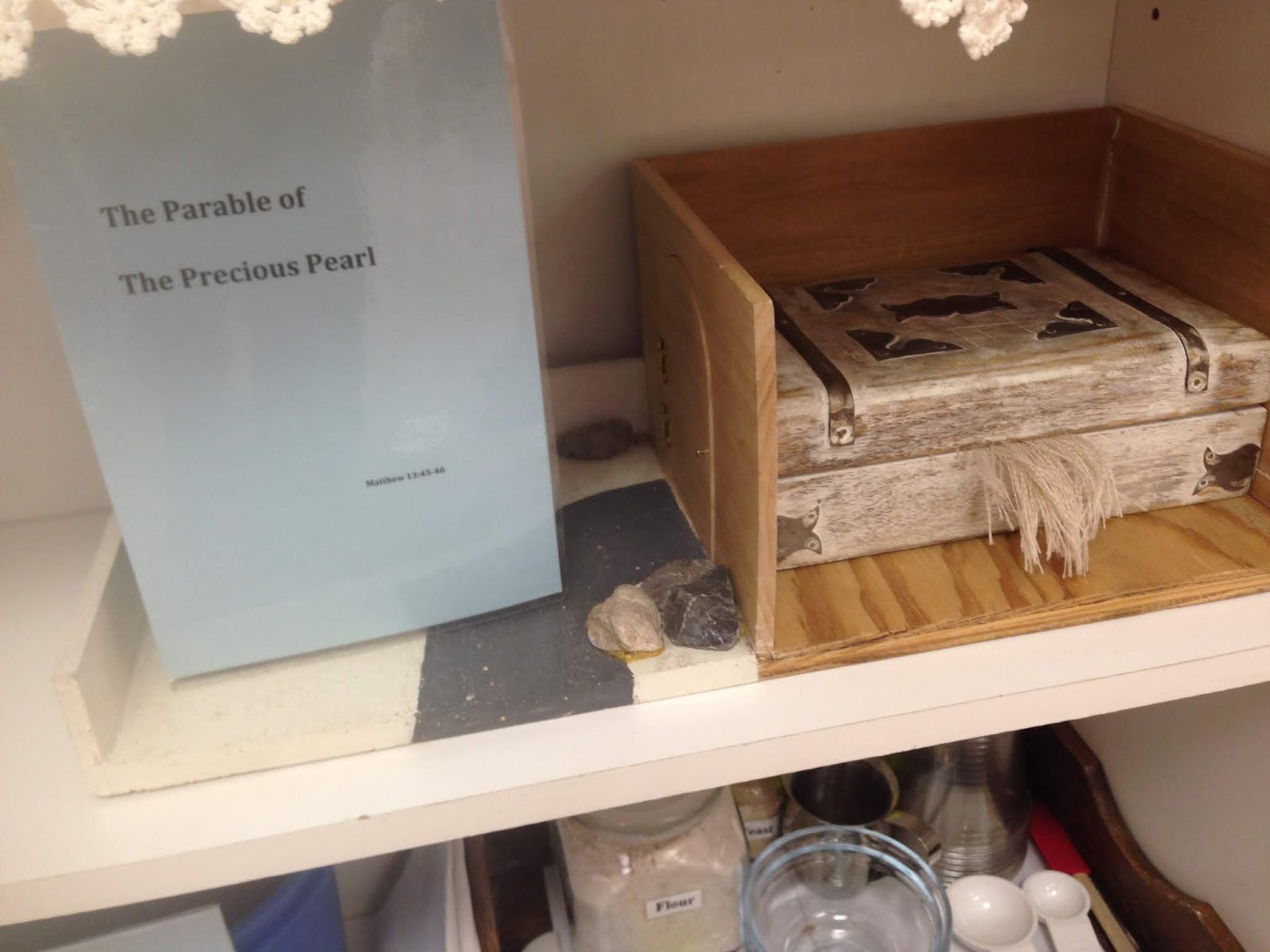
This parable is very popular with the Level I children, ages 3-6.  They love looking into the small treasure boxes.  The merchant gives up everything he owns to acquire heaven.  This theme is also seen in The Hidden Treasure parable.   I stained the inside of the merchant's house and painted the outside market with paint and sand for texture .  I also glued rocks outside the door.
   
The small treasure chests I purchased at second hand shops and a store which sells items from around the world.  I glued the jewels in the boxes because otherwise  curious hands take things out of the box and they get all over.  Even when glued after a couple of years they pick them out so I have to glue new ones in to replace them. At the end of every year there are repairs to do over the summer and some repainting of the figures.  I enjoy improving on the materials each summer as I get some creative ideas after I present the Scripture.
I chose a very large pearl to be the pearl of Great Price.  However, I've seen others who have used one small pearl.  The larger pearl makes sense to me when you compare this parable to The Mustard Seed, where it says that the Mustard tree is so large it has branches for all the birds of the air.  Heaven must be pretty big then, right? 

I tried to get a box which would hold everything neatly.  I've drawn the shapes on the bottom of the box to help the children place the objects in the box as shown here so that the lid will close. 

I made sure to make the room so that the box would fit snugly on the small shelf.  It has a ribbon nailed to the lid for easy opening.  It has been very frayed and I'll need to replace it.           

In all honesty, I believe I could make this house myself.   Over the years I've become knowledgeable watching my husband do this work.  He's a perfectionist and uses glue and nails.  I'm sure I'd take short cuts like using Liquid Nails.  However, I now can use the Jig saw and small Band saw pretty well - not as afraid as I used to be. 


Click below "older posts" to see more presentations and postings.  Or click "home" to go to the beginning of the blog.