Friday, June 8, 2018

Pin Maps and Sharing a Level I and Level II Atrium


Sharing a Level I and Level II Atrium


 Level I Practical Life Skills material for the 3-6 year olds is covered with a small curtain while the Level II atrium is in session.  This includes brass and silver polishing, grasping, spooning, and pouring.  This also gets them ready for pouring cruets and makes the three year olds feel very comfortable and at home in the atrium. 


This is the same bookcase but with the curtain over the Level I materials during a Level II atrium.
The Synthesis of the Kingdom of God Parablesthe Mustard Seed, Pearl of Great Price, Grain of Wheat, and the Growing Seed are displayed on a silver tray.  Also, The Found Sheep and The Wolf and the Hireling are kept in the tapestry box on the top of the bookcase.  These are within reach of the Level II children.


 Two of the Moral Parables, The Found Coin and The Insistent Friend are covered with a small curtain during Level I.  I keep all the tracing packets and the Presentations for Baptism and Reconciliation in this bookcase that I got at St. Vincent's.  We keep our calligraphy materials in this bookcase, Missals and Prayer Journals along with Altar Work for Level II.


The Moral Parables presented during our Sacrament Retreat

On a bookcase behind this one (seen below) is kept The Healing of the Centurion's Servant, The Forgiving Father, The Pharisee and the Tax Collector (first shelf), The Wedding Feast, the Ten Bridesmaids (2nd shelf) and The Good Samaritan (bottom shelf).   This too is covered by a small white curtain during Level I atrium. 


Displayed is the Invitation to the Wedding Feast.  This is my favorite of all the moral parables.  It suggests so much about what God wants from his people.  It lays out four categories of human choice and what can happen when we have free choice and make wrong decisions.  However, He wants us to all to come to the Wedding Feast.  He is a forgiving Father.
I always compare this with the Good Shepherd when He says, "There are other sheep outside this sheepfold."  But He wants one flock; one shepherd.

Missal Work and Prayer Journals


On this bookcase you can see the Missal Work for Level II and the White Control notebooks for the Missals (left)  The top shelf houses the Level II Altar pasting work.  I am the Level II catechist for this atrium.  We have two atriums.  So I've tried to keep everything out of the main part of the atrium for Level I catechists in that it flows like a Level I atrium only.  I have a Wednesday and Thursday late afternoon/evening class and so I keep their Missal material separate on these two shelves.

The Gifts of the Kingdom are a very popular material for Level II.  There are small boxes of Herbs in the picnic basket and below are two drawers - one with small boxes of rocks and the other is filled with seashells and different sea life.  They like to sit in pairs and discover everything.


There are also a file basket on the top filled with downloaded pictures of animals, people helping others, along with rocks and rock formations, sea creatures and ocean scenes, flowers and trees - all God's creations!

The posters displayed across the wall belong to this work also.  It describes creation and how God put everything in place including this beautiful world of creatures and human helping others. On the four large tables are the foam board maps for the City of Jerusalem and the Pin Maps.  Our trainer for Level II always said, "Big work means big tables."  You can see why.  Normally the children stand to do this work, but when necessary they can use the tables to sit and work too.


                                                                                                                                     The Pin Maps

  The children find the name of the city on the control map (left) and then look for it on the larger mute map and place the flag on that location.  They are to do this with the mountain ranges, large land and mountain ranges as well as the bodies of water.  They are four control maps for them to choose from.  The red flag are the cities, blue for the bodies of water, green for the land masses and yellow
 for the mountain ranges.


The bookcase on the right shows where the Pin Map Flags are stored.  They are covered on the top shelf.  The large foam board maps are kept between the two bookcases behind this one as well as the City of Jerusalem foam board maps.
So everything has a place but does not disrupt the flow of the Level I children.  It becomes the job of the Level II catechist to put everything back in place for the Level I catechists and their children.  "A place for everything and everything in its place."  That's the Montessori way.
 
In the photo below I've taken the pins and replaced them with small wooden pegs and small block bases.  A lot less hurtful than getting stuck with a pin.  We put up with that for years until one of the catechists discovered these posts with bases at Hobby Lobby.  So much nicer now and more attractive.

Thursday, June 7, 2018

City of Jerusalem: Level I materials and a Level II material for the older children


Level I City of Jerusalem 

(Color coded for the 3-6 year olds)

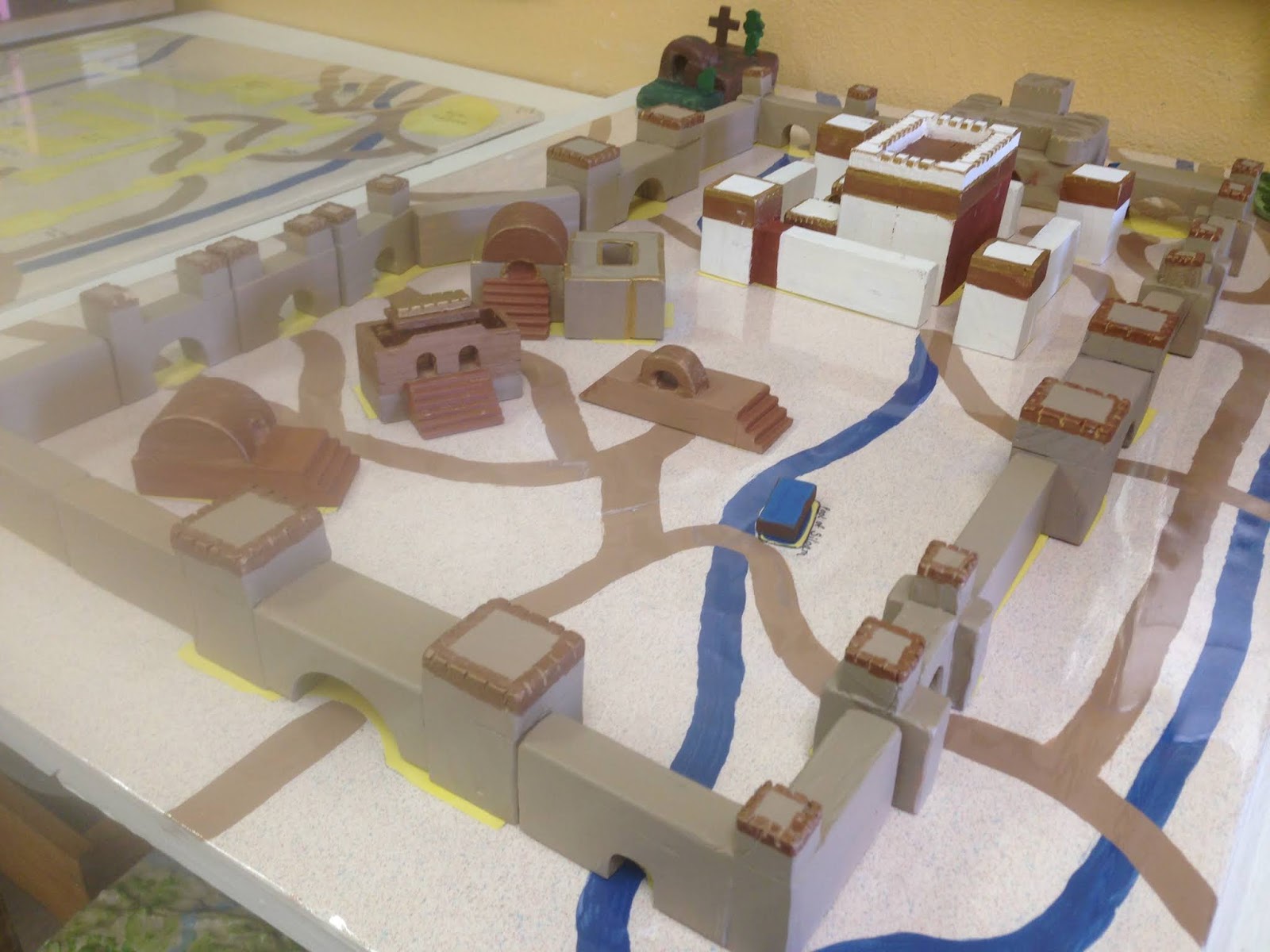
 This is the new Level I City of Jerusalem that we now have in our atrium.  The last Level I trainer we had, Kim Manville Sisson, taught the catechists how to build this material.   What makes this nice for Level I is that each building on the bottom is painted the same color and
same shape as its position on the map so the children know where to place it.  It is also the making it fun and easy for them.  However, overall it was colorless like oatmeal, so I gave it visual appeal and painted very lightly the whole landscape with rivers and paths.  It's very pretty now, I think.  I glued the tomb to the city's corner as the children didn't seem to know what to do with it.  When we present this work we present the path that Jesus took after leaving the Last Supper until he was crucified.  So it starts at the Cenacle, then the Garden of Olives, Caiaphas' Palace, to Pilate in the Tower of Antonia, to Herod and back to Pilate, and finally Golgotha. There is a control book for the catechist. 

I also painted the buildings and gave them gold accents.  We remade the Tower of Antonia using a Drummel as this was missing from the material.  Pictured below is how we show the children to put the work away in the box so they don't damage the materials.  They take pride in that work also.

I have made a control chart  on the top and inside lid of the box below which assists the children and the catechist.  Also, there is a booklet inside which tells the story of the Passion and is color coded.


Level II City of Jerusalem

  I also decided to paint the Level II City of Jerusalem which I had made from children's building blocks, a jig saw and drummel.  Everything is earth colors except for the Temple  as that was actually white with gold trim.

The Level II (7-9 year olds) can read from a booklet following the path Jesus took from the Last Supper to His crucifixion.  The children are told that they can put the walls of the city on the map after they follow Jesus' path.  Some children work in pairs and some just like doing it alone.


 There are two large maps with the shapes of the buildings and the walls cut out in yellow poster board which then are glued to the map.  The children place each of the buildings on the map and the next child removes the buildings to the  map on the table next to it.  There are two tables side by side.  The last person puts it back in the box as seen below. 

The pieces aren't to be thrown in the box carelessly.  They are put in like puzzle pieces neatly.
This is demonstrated after the presentation.


The Liturgy of the Eucharist and the Nativity Narratives with maps


On these shelves are the Liturgy of the Eucharist.  We begin by showing how the cruets are prepared with the water and wine.  I tell my Level II children that this prepares them if they want to be altar servers.  They are eligible once they have received their First Communion.  They learn all the gestures of the priest such as the "washing of hands," the "Doxology," and the "Epiclesis."  The 7 to 9 year olds can read and are expected to read the words of the priest as they imitate the gestures.  In the "washing of hands" they can work together with one child being the priest and the other acting as the altar server.
Finally, they learn how to do the "Preparation of the Chalice."  And again, the words must be read.  I love hearing their voices across the room reading softly these words.  They take it very seriously, as they should.

Later, we do the entire Liturgy of the Eucharist with a presentation called the Synthesis of the Mass which I will describe at a later time.

 
This bookshelf holds all the Nativity Narratives.  There is a Scripture booklet for each material.  This is so the children can read the Bible Story as they work with the material.  In Level II the children often can be seen reading to each other the Scripture passage while one moves the materials, the other reads.


These are the Tracing packets that go with each of the Nativity Narratives.  The children like to trace and make their own booklets and color them.  The large packets are for the  younger children in Level I and the small packets are for the older children.  However, they sometimes use either.


There is also a geography area in the atrium.  There are small wooden puzzle maps of Israel in Jesus time.  


There is also a Topographical map (left) which helps the children learn where the angel appeared to Mary in Nazareth; where Jesus was born in Bethlehem and where He died in Jerusalem.

The Atrium at St. Andrew the Apostle Catholic Church in Sierra Vista, Arizona

The Atrium at St. Andrew the Apostle Catholic Church

 This is a replica of our altar at St. Andrews.  The little white cabinet contains all the materials that the priest uses at Mass in miniature.  They are labeled with pictures and words so that even the three year olds can put them away when they are finished.  The children learn how to dress the altar and learn the names of the materials used in the Mass.  Children are like little sponges and they remember even the most complicated words like tabernacle, ciborium, crucifix, etc.  It's pretty amazing what they are capable of at such a young age. 


Below the plastic cabinet contains the vestments of the priest that he wears in the Mass.  On display is a chasuble in red which he wears for Pentecost.  The children learn what the colors signify and are able to name the vestments. We use songs which help them remember the feasts and colors in the Church Liturgical Calendar.
In the shelving on the right is art work for tracing and pasting that the children love to do making the vestments and tracing the symbols for the mass and the sacrament of Baptism.  As some of the children who come to this program have not yet been baptized,  it is important that they understand the sacrament they will be receiving and it's significance.

  With all the symbols of baptism along with the oils, we also show the children how to baptize each other using their fists to represent the small head of a baby, which they enjoy doing.  They take turns doing this and are very serious about it.  There are two presentations in the Level I (ages 3-6) and another more detailed presentation for the Level II (ages 7-9).

There is a candle ceremony during the Baptism presentation where each child receives the light of Christ after being blessed with each oil, the Oil of Catechumen (for goodness) and the Oil of Chrism (for courage).  We use the Paschal candle to light their candle as the Paschal candle is used next to the Baptismal Font in the church.  At Easter they learn the meaning of the symbols on the Paschal Candle and there is another candlelight ceremony during Easter as well.  The photo shows art work for the Paschal Candle as well as for Baptism.


The photo on the right is our prayer table.  There is a procession celebration to change the colors for the Liturgical year which the children love to do in Level I.  They sing a psalm while they process outside and come back to the room to redress the prayer table.  

In Level II, the children are introduced to the Bible in its entirety.  At left you see the outside of the cabinet which houses all the books of the Bible.  I usually do a short synopsis of each book and the book's purpose for the Jewish people in the Old Testament.  I might include a short story from different books to make it more interesting until I finish the New Testament.

There are large floor puzzles that the children use to name each book of the Bible and we use songs as well.  The floor puzzle is kept under the prayer table and you can see in the photo a basket under the Holy Bible cabinet where another smaller version is kept.  Each puzzle has a control chart with all the answers.  I usually give a prize if they complete this work.  It takes most of the hour to do.  The religious medals, 

 pins, key rings and holy cards are donated by  parishioners.  I asked one of the office staff if they could help me with this, and I am pleasantly surprised every year and always have enough to last the year.

Each book of the Bible is numbered and the name of the book is on the front.  After asking the children if they notice any differences in the books, they always notice first the sizes.  I tell them that the tall books mean that these are longer stories and the smaller books are shorter.
 This cabinet (left) represents the Cenacle (or Upper Room as it is more commonly known).  It has door on the left side and there is a drawer under it containing the twelve apostles and Jesus made from Sculpy clay.   I make all our figures from Sculpy.  I've seen a figure bounce twice on the hard floor and never break.  It's a tough material after being baked.


My husband has made all the cabinetry for the atrium as well as the little houses for the Nativity narratives, while I do the small sculptures, wood finishing and painting.
You might have noticed that the backdrop of the Cenacle is the Jewish Candelabra for Passover, called the Menorah, I believe.  That can be turned around and on the other side there is the same altar background that we have in our church and on the little model altar.  This is used when we do the "Origin of the Eucharist" to explain the history of when priests and bishops began their work in the Catholic Church and mass until today.   There are ancient papers as far back as 100 A.D. describing the mass in great detail just as it is today.

In Level II, we prepare the children for Reconciliation (Confession) and Holy Eucharist (their First Holy Communion).   Although we read the Ten Commandments in the Bible together and discuss them at their level, our Level II program uses the Maxims (Jesus' own words in the Bible) to discuss sin and what it is.  For example, "Do to others as you would have them do to you."  That leads into a lot of discussion with 7-9 year olds.  They have amazing questions and input which always surprises me.  The white cabinet above contains twelve of the Maxims and the Greatest of all Commandments is on the left, "Love your God with all your heart, with all your soul, with all your mind, with all your strength and love your neighbor as yourself."  By the time we are finished discussing all these wonderful Maxims, they are ready for the Sacrament and understand what Reconciliation is all about.

Monday, May 28, 2018

Reenactment of the Last Supper I (2018)


Another favorite of the children is reenacting the Last Supper.  This year I lengthened the play to include the Garden of Gethsemane as the children do not want the play to end.  In the past they have  asked to wear their costumes until the end of class.  I also added Scenes 1-6 to the play so there would be action as well.  I use a Raspberry Lemonade for the wine and Peta bread for the unleavened bread.

I didn't have many good readers as they are mostly 2nd graders.  There are a few who have English as their second language, so I simplified the vocabulary in the script.  The person who plays Jesus has to be the best reader as there is so much for that child to read.  This year Jesus just happened to be a girl.

I look forward to the Easter season.  By this time they have heard the Last Supper and the Tomb presentations before we do this little play.   We have also been through the entire liturgy of the Eucharist and the children have a pretty good grasp of what the mass is all about.  So this is the culmination of all that work.

 The costumes aren't elaborate as you can see - just some earth and sky tone materials with white cording to hold the scarves on their heads that I bought at Walmart.  I have 16 script parts to include the Blessed Mother and Mary Magdalene, if everyone is present that day.  Each have one or two narrator parts to read.  It is by far their favorite day in the atrium when I ask them.

I keep all the materials I use for Easter Season in this old desk I bought at our church bazaar.  That includes the Scripts, costumes, and apostle name cards on ribbons for the Reenactment of the Last Supper along with the Meditation of the Passion Booklets.  I also keep the True Vine and the grapes I use on the prayer table which decorate a large cross.  I've decided that next year I'm going to let the children wear the costumes for the Meditations as it will allow them to feel a part of the Passion and they love wearing them.  There is also a Crucifix, two candles and a silver plated plate used for the Peta bread kept here.